
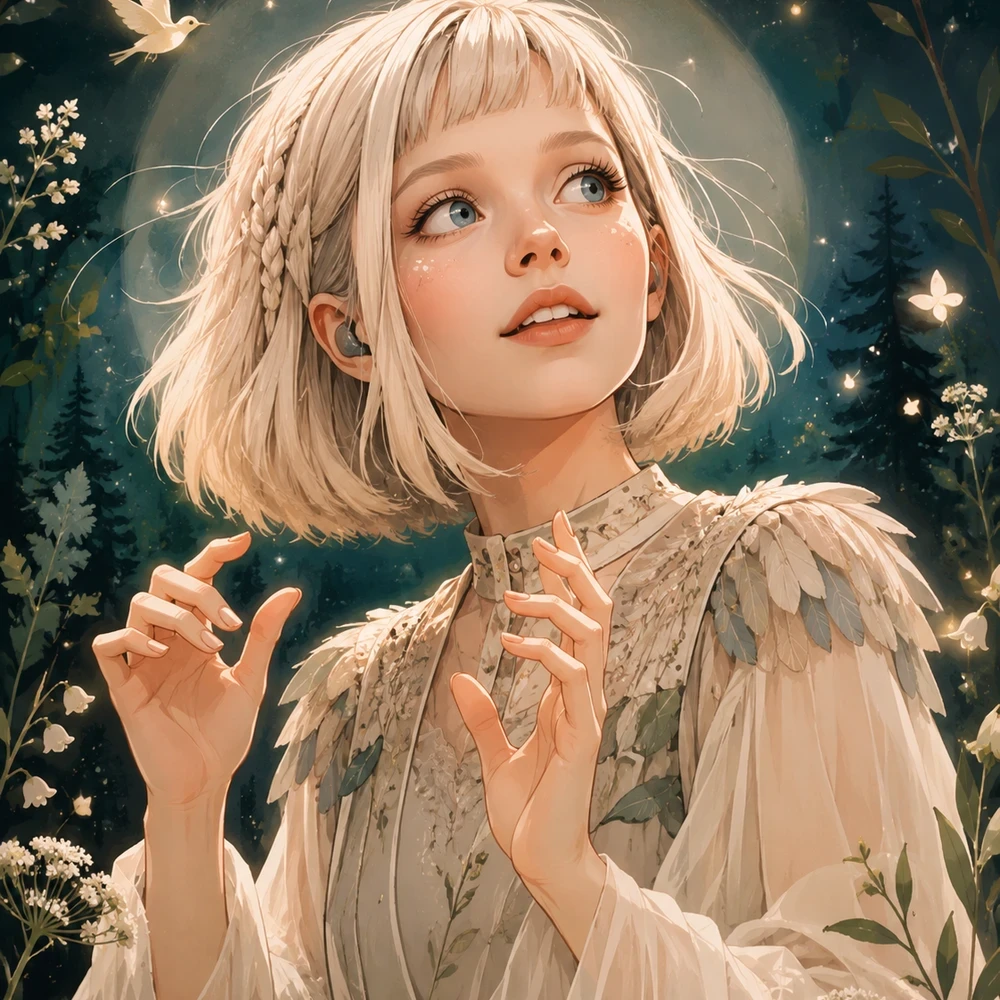
There are artists you can place after a single song. You hear three chords, a vocal colour, a production formula, and you more or less know where you are. That can be pleasant. Music is allowed to be recognisable. But there are also artists who do something different. They do not lead you into a familiar street, but to a place where the path suddenly ends. That is where it begins. Aurora is one of those artists.
The Norwegian singer Aurora Aksnes, better known as AURORA, is difficult to put into a box. Of course, you can mention names. Kate Bush. Sally Oldfield. Björk. Perhaps also Enya, Florence Welch, a dash of Scandinavian folklore, a touch of electronic art pop, a body that dances as if it does not entirely belong to this world. But the moment you try to pin her down with those references, she slips away again. Aurora is recognisable precisely through her elusiveness. She is a crossing of many influences, and at the same time, above all, herself.
That becomes completely clear when you listen to the fantastic song “Churchyard”, especially in the live version she performed for KEXP, recorded in 2018 during Iceland Airwaves in Reykjavik. For me, that performance is a kind of summary of who Aurora is. Not because it explains everything, but precisely because it explains nothing neatly. The song is not an ordinary pop song. It is song, ritual, theatre, incantation and release all at once.
With Kate Bush, I think of the theatrical body. With her, singing is never only singing. It is gesture, gaze, movement, character, story. The voice is never separate from the body; the body sings along. Aurora has that too. Anyone who sees her perform does not see a singer standing neatly behind a microphone to deliver a good little song. She moves as if the music has to pass through her, as if she is not only singing the song but also exorcising it, summoning it, pushing it away, embracing it.
With Björk, the kinship lies in the strange, organic, almost extraterrestrial quality. Björk makes music that sometimes sounds as if it has been made of ice, moss, electricity, volcanic soil, childlike wonder and nightmare all at once. In fact, that is often exactly what she does. Aurora has something similar. In her work too, nature never sounds like scenery. Nature is not a pretty picture in the background, but a force, a being, a voice. Her music can be soft and fragile, but underneath there is often something wild. Something that does not quite want to be tamed.
With Sally Oldfield, I hear that clear, almost pastoral light. A voice that can have something Celtic about it, something rounded, something with waterfalls in it. That too is sometimes present in Aurora, especially when she sings in multiple layers. Not always, because she can also be dark, angular and electronic. But her voice regularly contains a clarity that is not clinical. She does not sound polished. She sounds as if there is breath, skin, air and landscape in her singing.
And yet Aurora is not the sum of these names. That is the danger of comparisons. You mention three predecessors and think you have explained someone. But with Aurora, the interesting part begins precisely after the comparisons have been made. She has the theatricality of Kate Bush, the idiosyncratic otherworldliness of Björk, sometimes the pastoral clarity of Sally Oldfield, but she turns it into something that feels strikingly natural.
She does not seem to strive for smoothness. A lot of pop music wants to convince, seduce, hold on, sell. Aurora is more likely to leave a door open to a room you are not entirely sure you are allowed to enter. Each song has its own logic. Sometimes you hear folk, sometimes synth pop, sometimes something almost choral, sometimes dark electronics, sometimes a children’s song lost in a dream. And yet it remains recognisably Aurora.
“Churchyard” is exemplary in that respect. The song comes from the album Infections of a Different Kind – Step 1, a record on which Aurora moves between art pop, electronics, choir-like vocal lines, rhythmic tension and themes that are larger than the usual subjects of pop music. Her work is often about the body, nature, vulnerability, violence, love, connection, powerlessness and strength. But she does not turn these things into pamphlets. She turns them into worlds.
In “Churchyard” you hear something threatening and something sacred at the same time. Even the title: a churchyard, a walled place, a place where the living relate to the dead. But the song is not only dark. It also has something combative about it, something that rises up. That is typical of Aurora. She can make vulnerability sound without becoming weak. She can evoke darkness without disappearing into it.
The KEXP version makes this even clearer. KEXP has a particular strength as a stage: it is sober, direct, without a grand circus around it. No fireworks, no stadium tricks, no enormous show machine. Just musicians, cameras, microphones and a small room. In such a setting, an artist has to rely on presence. And Aurora has presence in abundance.
In that performance of “Churchyard” you see how her body is part of the music. Her hands move as if, like a white witch, she is drawing magic from the air. Her eyes sometimes seem turned inward, and then again toward something beyond the room. She is not standing there as someone reciting a song. She is standing there as someone opening a small ceremony. That may sound grand, but with Aurora it is not exaggerated. Her best performances have something ceremonial about them. Because she takes music seriously in a way that seems older than entertainment.
And at the same time, she does not always take herself seriously. That is beautiful too. In interviews, you often see that she does not play along with the usual conventions of conversation. As if she is thinking: do I really have to give a tidy answer to every question? Why, exactly? She plays with language, with silence, with confusion, with evasion. Sometimes she seems genuinely amazed by the seriousness with which others approach the pop world. She knows how the game works, but she does not seem willing to be swallowed by it completely.
That makes her akin to Björk. Björk too is not just a singer, but an ecosystem of her own. With her, sound, image, clothing, body, nature, technology and mythology belong together. Aurora moves in a similar direction, but with a different temperature. Björk is often volcanic, experimental, architectural. Aurora is more fluid, more forest-like, sometimes more childlike, but no less powerful for that. Her world is less laboratory and more clearing in the woods.
That Aurora has been influenced by Björk is therefore not hard to believe. The kinship can be heard and seen. In the sense that she makes use of the same artistic right as Björk: the right to be strange. The right not to be merely beautiful, attractive, marketable or understandable. The right not to treat a song only as a product, but as a living being.
That is rare at a time when much music is expected to be consumable ever more quickly. Aurora does not ask for quick consumption. She asks for surrender. You have to entrust yourself, a little, to her world. Those who listen only in search of a chorus that immediately sticks in the head may miss half of it. Those who listen for texture, breath, rhythm, gesture and atmosphere hear much more.
Her collaboration with Brian Eno also fits that picture. Eno is one of those figures in pop music who has always understood that music is not only melody and lyrics, but also space, atmosphere, environment, attention. He is the man of ambient, of soundscapes, of production as a form of thinking. That Aurora should be associated with Eno therefore makes sense. Both have something to do with music as environment. Not only a song you hear, but a space you enter.
In 2024, “A Soul With No King” appeared in a version in which Aurora, Nature and Brian Eno came together within the context of EarthPercent and the Sounds Right project, in which nature is presented as a co-artist. That idea alone already suits Aurora: nature not as a romantic postcard, but as a voice, almost as a legal person, as a presence. With her, that does not feel like a marketing concept. It connects to what she has been doing for years: making the boundary between human being, body, earth, dream and sound porous.
That is why Aurora moves me. Not because every song is immediately equally accessible, and not because she always chooses the shortest route. Quite the opposite. I love artists who walk every path except the paved one. Artists with whom you do not know in advance what the next song is going to do. Artists who are a little weird, because they have not been completely smoothed out by the expectations of audience, industry and media.
Aurora is such an artist. She can be fragile, but also wild. She can seem girlish and ancient at the same time. She can dance as if something is moving through her. She can be evasive and playful in interviews, but suddenly completely present on stage. There she does not have to explain who she is. There she simply is.
For me, “Churchyard” is therefore not just a coincidentally good song. It is one of the keys to her personality, as are several other songs on the album mentioned above, which is now already eight years old. Anyone who wants to meet Aurora should really watch this performance.
This woman makes music as if she still believes that a song can summon something. Not only applause, not only recognition, not only streams, but something older than the pop industry. A memory of the fact that music once began as incantation, as dance, as mourning, as consolation, as fire in the night. In “Churchyard” you hear all of that.
And then you remember why some artists are necessary. Not because they fit neatly into what already exists, but because they remind us that beyond the beaten track, people are still singing. Does that have anything to do with “mad about customers”? I do not know. In any case, we are not being deceived. It is authentic. And that too is a form of respect for your audience.
bertoverbeek.com
(This blog has been published on gekopklanten.nl in Dutch)
Deel uw ervaringen op ManagementSite
Wij zijn altijd op zoek naar ervaringen uit de praktijk, wat werkt wel, wat niet.
SCHRIJF MEE >>
Als u 3 of meer artikelen per jaar schrijft, ontvangt u een gratis pro-abonnement twv €200,--