
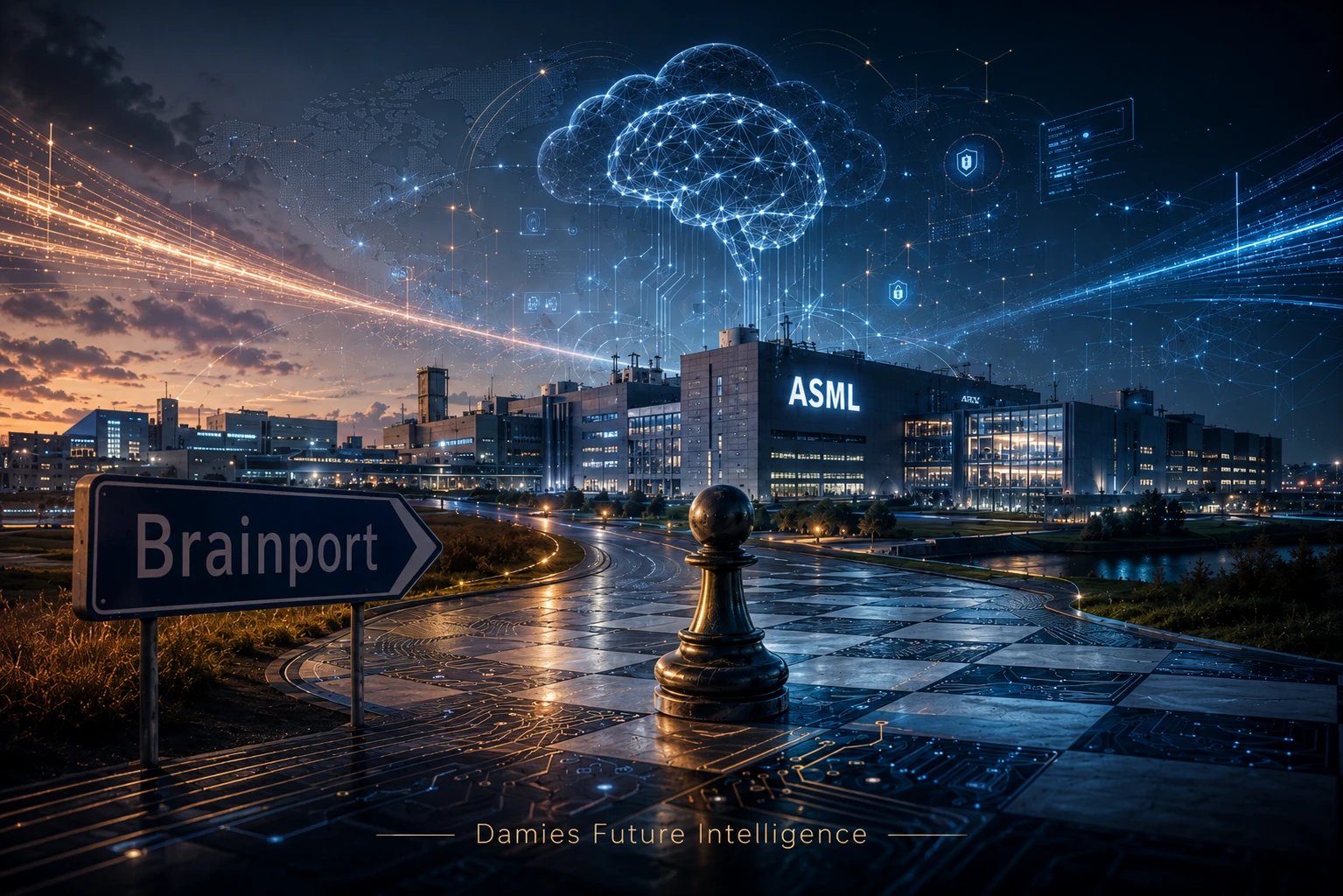
Brainport Eindhoven has long been described as one of Europe’s most important high-tech regions. With ASML as its strategic anchor, the region is no longer simply a successful industrial cluster. It has become a geopolitical pressure point.
That was the central premise of the earlier scenario analysis on ASML (Dutch), Brainport and the future of the Dutch economy. The question then was whether Brainport would become a pawn or a pivot: a region acted upon by global forces, or a region capable of shaping its own strategic destiny.
Recent developments make that question sharper.
ASML still confirms a long-term growth opportunity towards 2030, driven by artificial intelligence, advanced logic, memory and the continuing relevance of EUV and High-NA EUV. At the same time, the company has announced job reductions and organisational streamlining. This is the efficiency-frontier of the AI-era: explosive demand for the product, but a lean, automated architecture for the producer.
It is the new paradox of the AI economy: explosive demand at the top of the value chain, combined with pressure to simplify, automate and remove layers elsewhere.
Brainport is therefore not entering a simple growth phase. It is entering a more selective phase of growth.
The second development is the rising strategic importance of advanced packaging. Besi, another Dutch semiconductor equipment company, has moved closer to the centre of the AI hardware race because of hybrid bonding. In a world of AI chips, high-bandwidth memory, chiplets and energy-intensive data centres, value is no longer created only by making features smaller. It is also created by connecting chips faster, denser and more efficiently.
That matters for Brainport. If ASML is the lithographic heart of the global chip system, Besi represents the synaptic layer: the connection layer that allows AI hardware to scale. The Netherlands is therefore not only home to one strategic choke point. It may be home to several.
But the most recent and perhaps most revealing development is not about machines at all. It is about access to AI models.
The decision by the United States to restrict foreign access to Anthropic’s Fable 5 and Mythos 5 models shows that export control is moving into a new phase. Until recently, the geopolitical debate focused mainly on chips, lithography machines, datacentres and export licences. In other words: the physical infrastructure of the AI economy.
Now a second layer is emerging: access to AI capability itself. That changes the ASML scenario fundamentally.
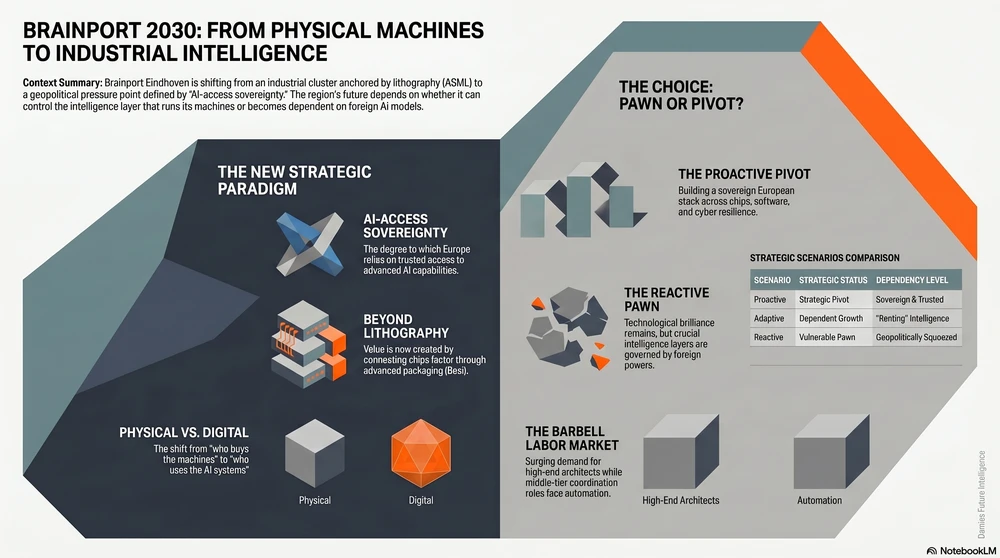
The old question was: who may buy the machines that make the chips?
The new question is: who may use the AI systems that design, secure, optimise and accelerate the machines, the software, the factories and the supply chains behind those chips?
This is where AI-access sovereignty enters the picture.
By AI-access sovereignty I mean the degree to which Europe, the Netherlands and Brainport can rely on stable, trusted and politically resilient access to advanced AI capabilities. Not only for chatbots or office productivity, but for software engineering, cyber defence, systems architecture, supply-chain optimisation, chip design, vulnerability detection, process control and industrial decision-making.
For Brainport, this is not an abstract policy issue. It goes directly to the operating system of the region.
A semiconductor ecosystem is no longer built only from cleanrooms, optics, mechatronics and precision engineering. It is increasingly built from models, APIs, secure clouds, autonomous agents, synthetic testing environments and AI-driven engineering workflows. The physical and the digital are fusing into one industrial nervous system.
That means the three original scenarios need to be updated.
In the proactive scenario, Brainport becomes part of a trusted European AI-semicon stack. ASML remains the technological anchor, but it is surrounded by a broader strategy for secure AI, cybersecurity, advanced packaging, industrial cloud infrastructure, chip design, materials science and systems engineering. Europe does not merely invest in fabs or subsidies. It builds trusted capacity around the full chain: from lithography to bonding, from software to cyber resilience, from talent to sovereign compute.
In that scenario, Brainport becomes more than a region of machines. It becomes a strategic platform for European industrial intelligence.
This does not mean isolation from the United States or Asia. Brainport will remain deeply international. But it does mean that the region avoids becoming dependent on a single external switchboard for the AI capabilities needed to run its own strategic industries.
In the adaptive scenario, Brainport remains strong but becomes increasingly dependent on American AI models, cloud platforms and access regimes. The region continues to grow, ASML keeps its core in Veldhoven, Besi and other suppliers remain relevant, and Project Beethoven helps relieve pressure on housing, infrastructure and talent. Yet a permanent compliance tax emerges.
Companies must constantly navigate export rules, national-security classifications, data-residency demands, cyber requirements, nationality restrictions and platform dependency. Brainport can still function, but its room for manoeuvre narrows. It rents part of its intelligence layer from elsewhere.
This is not collapse. It is dependency with good margins.
The reactive scenario is darker. Here, Brainport remains technologically brilliant but geopolitically vulnerable. Critical AI capabilities can be restricted, delayed or withdrawn by foreign governments or platform providers. Suppliers that lack capital to digitise and diversify become squeezed between ASML’s requirements, Asian production shifts and AI-driven efficiency demands. Talent follows the places where frontier tools, compute and strategic projects remain accessible.
In this scenario, Brainport does not fail because its technology is weak. It weakens because crucial parts of the intelligence layer around that technology are governed elsewhere.
This has direct consequences for work.
The Brainport labour market will increasingly show barbell characteristics. At the left end, demand will grow for AI engineers, systems architects, cybersecurity experts, reliability specialists, computational lithography experts, advanced packaging engineers and people who can connect physical production with digital intelligence. At the right end, operational, technical and support roles will remain necessary because high-tech ecosystems still need hands, logistics, maintenance and execution.
The pressure point is the middle. Roles that mainly coordinate, transfer information, monitor processes or translate between systems without adding deep judgement may come under pressure from AI and automation. Brainport can become richer and more vulnerable at the same time.
That is the uncomfortable lesson of the current phase.
The policy answer cannot be only “more ASML”. Nor can it be only “more houses”, “more roads” or “more engineers”, although all three remain essential. Project Beethoven was necessary, but the next step is broader. The Netherlands needs an industrial intelligence strategy.
Such a strategy should connect five domains: semiconductor equipment, advanced packaging, secure AI access, cyber resilience and human capital. It should help suppliers digitise before they are forced to move or merge. It should make trusted AI capability available for critical industrial use. It should strengthen European cloud and model access for strategic sectors. It should treat talent policy as national security policy, because without people, machines do not become ecosystems. (Human Capital Allocation Framework)
Above all, it should recognise that ASML’s strategic importance is no longer only about lithography. ASML now sits at the intersection of chips, AI, security, global power and regional social stability. The same increasingly applies to the broader Dutch semiconductor ecosystem around Besi, ASM, NXP, VDL, KMWE and the many specialised suppliers that make Brainport work.
Brainport’s future therefore depends on a subtle but decisive shift in perspective.
The region should not ask only whether ASML will grow. It should ask whether the Netherlands can convert ASML’s and Brainport’s position into strategic agency. That is the real choice between pawn and pivot.
A pawn waits for the board to move. A pivot helps define the board.
The recent developments around ASML, Besi and Anthropic, one of the frontier models, show that the board itself is changing. It is no longer made only of machines, chips and factories. It is increasingly made of access, intelligence, compute, trust and control.
The old strategic question was who controls the machines that make chips, the new strategic question is who controls the intelligence that improves, protects and redirects those machines?
For Brainport, that question may define the road to 2030.
Willem E.A.J. Scheepers, Strategist & AI Implementer

Gerelateerde artikelen

Musk at the Gate: Terafab, ASML and Brainport’s Next Sovereignty Test.
Willem E.A.J. Scheepers
The AI Barbell Model: Why Work Is Splitting in Two.
Willem E.A.J. Scheepers
Deel uw ervaringen op ManagementSite
Wij zijn altijd op zoek naar ervaringen uit de praktijk, wat werkt wel, wat niet.
SCHRIJF MEE >>
Als u 3 of meer artikelen per jaar schrijft, ontvangt u een gratis pro-abonnement twv €200,--