
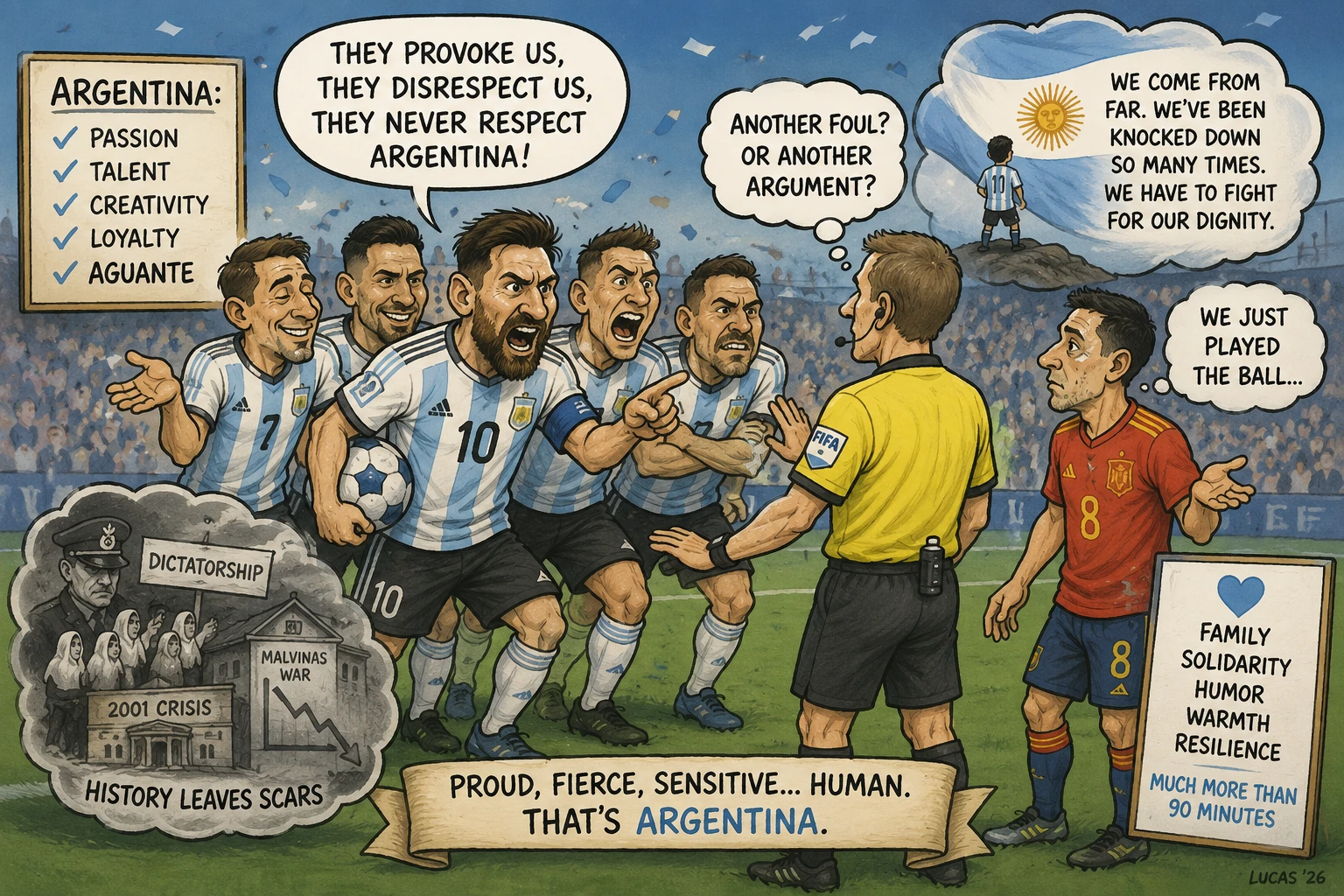
Anyone who followed Argentina during the 2026 World Cup could hardly ignore the less attractive sides of the team. They played hard, protested repeatedly against refereeing decisions, and reacted fiercely whenever opponents responded in kind. After the lost final against Spain, things escalated further. Leandro Paredes pushed the Spanish player Gavi to the ground, after which a confrontation broke out. FIFA subsequently opened a disciplinary investigation into the conduct of several Argentine players.
It was tempting to dismiss these events as isolated incidents. Losing a World Cup final releases powerful emotions, and fights after major matches are hardly an Argentine invention. Yet throughout the tournament, something more seemed to be happening. There was a recurring combination of provocation, physical play, loud protest, minimising one’s own fouls, and collectively confronting the opposition whenever they retaliated. This created the image of a team that almost constantly saw itself as the victim while simultaneously pushing the boundaries itself...
The Argentines could dish it out, but seemed less able to tolerate it when an opponent did the same. As soon as one player became involved in a conflict, others immediately joined him, even when it was not at all clear what had actually happened.
That behaviour first of all says something about this particular squad and its internal culture. Yet the team is not completely detached from the history and identity of the country it represents. To understand why Argentine footballers can behave in this way, one has to look at a remarkable combination of national pride, lost greatness, group loyalty, and historical grievance.
A country with an exceptional self-image
Argentina has long regarded itself as an exceptional country within Latin America. At the end of the nineteenth and the beginning of the twentieth century, its economy grew rapidly. Millions of immigrants, especially from Italy and Spain, settled there. The Argentine elite saw European immigration as a way to build a modern, prosperous, and Western-oriented nation.
From this emerged the image of Argentina as the most European country in South America. Buenos Aires presented itself as the Paris of the southern hemisphere. Literature, architecture, music, and science reached a high level. The country saw itself as culturally sophisticated and as a future world power.
That self-image also had a darker side. Indigenous and Afro-Argentine history was marginalised or written out of the national story. Argentina liked to present itself as a white, European society, which could encourage a certain cultural superiority towards other Latin American countries.
This may be one of the origins of the attitude that outsiders sometimes experience as Argentine arrogance. The culture of Buenos Aires in particular has a pronounced, verbally self-assured style. People debate passionately, use grand language easily, and may sound ironic or condescending. Confidence and theatricality often lie close together.
It is important not to confuse this with the character of every Argentine. Every national culture contains enormous internal differences. Yet there are styles of behaviour that are more readily rewarded in one society than in another. In Argentina, forceful self-presentation can be admired. Modesty is less automatically regarded as a virtue than it is in a country such as the Netherlands.
The memory of lost greatness
Argentine self-confidence becomes more complicated because the country never fully realised its earlier expectations. Between roughly 1870 and 1930, Argentina was prosperous by international standards. This was followed by periods of economic stagnation, political instability, military coups, inflation, and debt crises.
A painful contradiction emerged. Argentina continued to see itself as a great and exceptional country while repeatedly being confronted with economic decline and political failure. Its national self-image became both grand and fragile.
That combination can produce defensive pride. People who are deeply convinced of their own value, yet repeatedly feel that this value is not recognised by others, may become hypersensitive to humiliation. Criticism is then easily experienced as disrespect. An ordinary setback can take on the meaning of injustice.
On the football field, this mechanism becomes visible. Argentina does not merely want to win. It wants to be recognised as a great football nation that no one is allowed to underestimate. When opponents resist, when a referee does not support the Argentine narrative, or when another team celebrates a victory exuberantly, this may be experienced as an attack on honour.
The Argentine players are therefore sometimes defending more than a result. They are defending an idea of Argentina.
The street boy who defeats the establishment
Argentine football has produced its own national myth: that of the pibe, the bold, creative street boy who outwits stronger opponents through talent and cunning.
The pibe is not a polished, disciplined sportsman. He improvises, challenges authority, and refuses to submit to the rules of the powerful. Maradona was the greatest embodiment of this figure. He came from poverty, played with an almost childlike freedom, and conquered the football world through genius, cunning, and nerve.
There is something deeply attractive in this. Argentine football culture values creativity, courage, and inventiveness. A player does not have to be the product of a wealthy family or an elite academy. He can come from a poor neighbourhood and conquer the world.
At the same time, the line between cleverness and deceit can become thin. Those who experience the rules of the powerful as hostile feel less morally obliged to obey them precisely. Provoking a foul, wasting time, exaggerating contact, or disturbing an opponent’s concentration may then be seen as part of the game.
Victory does not have to be achieved through superior football alone. Psychological dominance also matters. The opponent must feel that Argentina cannot be intimidated.
Aguante: we never abandon one of our own
An important concept within Argentine football culture is aguante. The word refers to endurance and steadfastness, but in football it has acquired a broader meaning. It means tolerating pain, showing courage, protecting one’s group, and never backing away from confrontation.
Within sections of the football culture, aguante can become linked to honour, masculinity, and a willingness to use violence. Those who stand their ground and refuse to be humiliated gain status within the group.
This makes the collective behaviour of Argentine players easier to understand. When one player is pushed or confronted, teammates respond immediately. First they take sides. Only afterwards might the question arise of who was actually in the right.
From the outside, this looks like herd behaviour. From the inside, it is proof of loyalty. An Argentine player does not leave his teammate to face an opponent alone.
That comradeship is also a source of strength. Argentine teams can form exceptionally close groups. Players fight for one another, endure pain, and are prepared to put personal interests aside. The 2022 World Cup victory was partly built on that strong collective feeling.
The same principle, however, becomes unpleasant when loyalty matters more than self-criticism. A teammate is then defended even when he initiated the provocation or committed the foul himself. Solidarity turns into moral blindness.
Giving as good as they get, while still feeling victimised
Perhaps the most striking feature of Argentina’s behaviour during the World Cup was the combination of power and victimhood. The team behaved like a world champion demanding respect, yet often spoke and reacted as though it were constantly being disadvantaged.
Psychologically, this combination is less strange than it appears. Groups with a strong sense of historical grievance can see themselves as both superior and victimised. They interpret their own aggression as necessary resistance, while identical behaviour from an opponent is experienced as an attack.
An Argentine foul then becomes fighting spirit. A Spanish foul becomes provocation. Argentine protest becomes a defence of justice. When the opponent protests, it is considered unsporting.
One’s own behaviour is explained by circumstances. The behaviour of the other side is explained by character.
This mechanism exists everywhere. Supporters of almost every country judge their own team’s fouls differently from those of the opposition. Within Argentine football culture, however, it appears to be reinforced by a deeply rooted story: we have to fight because no one gives us anything.
As a result, even a highly successful team can continue to see itself as the underdog. Argentina entered the tournament as the reigning world champion and fielded famous players from Europe’s biggest competitions. Emotionally, however, the image remained that of poor street boys confronting a wealthy and hostile outside world.
Football as the defence of national dignity
For Argentina, football is more than entertainment. It is one of the principal arenas in which the country has compelled the world to recognise it.
Economically and geopolitically, Argentina is not one of the dominant global powers. It has repeatedly experienced dependence on foreign investors, creditors, and international institutions. In football, Argentina can defeat the wealthiest countries directly. For ninety minutes, the usual power relations no longer apply.
This gives victories an almost political meaning. When Argentina defeats England, France, Germany, or Spain, it is not merely a football team that has won. In the national imagination, a peripheral country has defeated the established world order.
The victory over England in 1986 acquired such enormous symbolic meaning partly for this reason. Four years earlier, Argentina had lost the war over the Falkland Islands, known in Argentina as the Malvinas. The military regime had sent young and often poorly equipped conscripts to the islands. The country felt both defeated by Britain and betrayed by its own leaders.
Maradona’s goals against England could not undo that history. Yet they were experienced as symbolic revenge. The small Argentine defeated a former imperial power through genius and audacity.
That historical weight does not simply disappear. Football remains a place where Argentina can restore national dignity and answer foreign humiliation.
Genuine reasons for distrust and grievance
It would be too easy to describe Argentine victimhood as mere self-pity. The country has lived through genuinely traumatic periods.
During the military dictatorship from 1976 to 1983, civilians were abducted, tortured, and killed. Many disappeared without trace. The state, which should have protected its citizens, became a source of terror.
This was followed by defeat in the Malvinas War and recurring economic crises. During the crisis of 2001, access to bank savings was restricted, unemployment rose, and a large part of the population suddenly lost economic security. International financial institutions had considerable influence over economic policy.
For ordinary Argentines, this was not an abstract debate about economics. Savings evaporated, families became poorer, and governments changed at great speed. Trust in banks, politicians, and international institutions was badly damaged.
Those who repeatedly experience the failure of official institutions learn to rely on family, friends, and their own group. The rule that “we never abandon one another” is therefore not only a form of macho behaviour. It also developed in a society where institutional protection could not always be taken for granted.
This is the more positive origin of Argentine collectivism. Loyalty, family ties, and mutual solidarity are strong. People can be warm, generous, and exceptionally loyal. The comradeship that becomes aggressive on a football field is the same comradeship that can keep people afloat in difficult circumstances.
The arrogant favourite who still feels like an underdog
Here lies the central Argentine contradiction. Argentina carries both a narrative of superiority and a narrative of victimhood.
The superiority narrative says: we are a great, European, culturally developed, and exceptional country. We produced Borges, Piazzolla, Maradona, and Messi. We belong among the best.
The victimhood narrative says: foreign powers, financial institutions, referees, and international organisations never treat us fairly. We have to fight for everything we receive.
Together, these narratives form an explosive combination. Those who regard themselves as great while simultaneously feeling unrecognised can behave both arrogantly and defensively. They demand admiration, but interpret criticism as persecution. They provoke from a position of strength and justify that provocation through a sense of victimhood.
At the World Cup, we saw a sporting version of this. Argentina was a powerful team, yet continued to present itself emotionally as a besieged community. The players could kick hard and then react indignantly to a minor foul by an opponent. They could provoke and then describe every response as disrespect.
The group reinforced this behaviour. As soon as one player felt insulted, the entire team felt insulted.
Explanation is not exoneration
The historical background makes Argentina’s behaviour more understandable. It does not automatically make it acceptable but we should be careul with too strong conclusions and wrong generalisation.
A history of dictatorship, economic humiliation, and foreign dependency does not give footballers the right to strike or intimidate opponents. Loyalty to teammates does not relieve anyone of the responsibility to think for themselves. Those who provoke others cannot endlessly appeal to the reaction that follows.
Nor should the behaviour of one football team be turned into a diagnosis of an entire people. Argentina is home to millions who reject aggressive stadium culture. The country also possesses powerful traditions of intellectual debate, human rights activism, literature, humour, and self-mockery. The Mothers of the Plaza de Mayo represent a very different form of Argentine perseverance: courageous, persistent, and non-violent.
Even within football, differences remain visible. Lionel Messi behaved with considerably more dignity after the lost final than several of his teammates. It was therefore possible to be Argentine, to be deeply disappointed, and still to show self-control.
The best conclusion is therefore not a simple condemnation. The Argentine team displayed behaviour that was arrogant, manipulative, and at times aggressive. Yet this behaviour did not emerge from nowhere. It grew from a culture in which honour, group loyalty, creativity, and resistance are highly valued, and from a history that gave Argentines genuine reasons to distrust authorities and outsiders.
Argentine football carries both the beautiful and the ugly sides of that past. The pibe who refuses to submit can be an admirable hero. He can also become someone who believes that rules are mainly for other people. Aguante can mean courage and loyalty. It can also become intimidation and collective blindness.
Perhaps that is what we witnessed during this World Cup: a great football nation that still plays as though it must prove itself to the entire world. A team strong enough to dominate others, yet still imagining itself deep down as the street boy obstructed by the powerful.
That does not make the behaviour admirable. It does make it more understandable.
Argentina sometimes provokes because it is strong. Argentina sometimes complains because it feels wounded. And because strength and wounded pride are so constantly intertwined, the boundary between passion and aggression can disappear with remarkable ease.
Deel uw ervaringen op ManagementSite
Wij zijn altijd op zoek naar ervaringen uit de praktijk, wat werkt wel, wat niet.
SCHRIJF MEE >>
Als u 3 of meer artikelen per jaar schrijft, ontvangt u een gratis pro-abonnement twv €200,--
Dear Bert,
Thank you for this article. Most people just call the Argentine players hotheads. You looked deeper. You linked their behaviour to national pride, to old greatness, to the ‘pibe’ myth, and to group loyalty. You also brought in real history: the dictatorship, the Malvinas war, and the 2001 crisis. You explain the behaviour without excusing it, which is not easy to do well. You did it well.
I want to add something to your piece by trying to look one step further back in history.
First, a word about Gyuri Vergouw's reaction to your piece. He shows that this pattern is old, going back sixty years. In 1966, Argentine player Antonio Rattín refused to leave the field after a foul and sat down on the red carpet made for the Queen. That event led to the red and yellow cards we use today. In the 1970s, Argentina played so rough that Ajax avoided matches against them for a few years, afraid of injuries. In 1978, Argentina played the World Cup under a military dictatorship, and Vergouw thinks that pain may still shape their behaviour today. He also notes that in 2026 Argentina got very few cards, and VAR decisions kept going their way — which suggests the behaviour is rewarded, not just allowed. After the final, player Leandro Paredes said nothing online about his own actions, only about pride in the flag. Vergouw sees this as a small sign that looking inward is not yet part of the culture.
Vergouw supports your idea that the pattern is old and keeps repeating. And I want to try to add another layer. I see it as a system with five steps: a wish, a cost, a result, a rejection, and a feedback loop:
1. The wish. In the late 1800s, Argentina's leaders wanted more than wealth. They wanted the country to be seen as truly European. Buenos Aires even called itself ‘the Paris of the south.’
2. The cost. To reach that wish, the country harmed its own people. Indigenous people were killed or driven off their land, in campaigns such as the Conquista del Desierto (1878–1885), with violence continuing into the 1920s. Black Argentines were sent to the front lines in wars, hit hardest by disease, and slowly written out of the census. Slavery lasted in Argentina until 1853, but schools still taught that Argentina simply was a white, European country, presenting this as a fact rather than a choice someone had made. One thing survived, though: tango. It came from Black neighbourhoods in Buenos Aires and became the elegant symbol of European Buenos Aires, with its real roots left out of the story.
3. The result. By its own measure, Argentina delivered. Borges became one of the great writers of the century. Maradona and Messi are, arguably, for some the two best footballers who ever played the game. Many families still carry their European names — Fernández, Scaloni, Di María. Argentina won two World Cup outright. It was an economic powerhouse in Latin America. The country is now linked to Europen royalty. Whatever the original wish asked for, Argentina produced it.
4. The rejection. And still, something is missing, and not because the achievement is too small. It seems that ‘being European’ was never something a country could earn from outside. It works more like a place that history assigns, one that talent and trophies cannot move.
There is also a strange twist: the proud, nationalist idea of ‘European’ that Argentina kept alive is close to the version that Europe itself moved away from, becoming more modern, civilized and more globally oriented. So the gap may not be about falling short of Europe. It may be about the two growing apart with differnt values and is the basis of Europe's rejection.
5. The feedback loop. That missing recognition doesn't just disappear. Inside the story, the price already feels paid, so the lack of recognition feels unfair to the Argentines rather than simply unlikely. But there is no clear place to send that feeling, so it comes out instead where Argentina can still act: in defensive pride, in aguante, in a team that feels wronged even while winning, in a push during a match. Vergouw's sixty-year pattern, kept alive by referees who keep rewarding it, shows how long this has had to become normal. There is also a smaller, more personal version of the same thing — someone dancing tango without knowing where it comes from, or taking a DNA test and finding Indigenous or African roots that school never mentioned and understand the he or she is not who they thought they are. And Europe is becoming more international by including onther people, not rejecting them. Look at the Dutch squad, the German, the Englidh, the Belgium, the Spanish. You 'll see other faces, that points to inclusion in the system, not being proud of exclusion.
I think your main idea still stands: a proud self-image, combined with unhealed history, creates pride that is easily hurt. And I just want to add an older layer underneath it. The dictatorship, Malvinas, and 2001 add up to about twenty years, and in each of them Argentina was mainly the one harmed. The story of Indigenous and Black Argentines spans centuries, and here it was Argentina's own leaders who caused the harm. That doesn't cancel the more recent pain — it suggests the wound may run deeper and older than your article covers.
One more point worth adding. Argentina built real, respected ways to remember the dictatorship's victims: the Mothers of the Plaza de Mayo, a human rights ministry, worldwide recognition. It has not yet built the same for Indigenous and Black Argentines. I don't see that as a contradiction so much as unfinished work — work that Argentine historians and activists are already doing, including a 2010 census that, for the first time in over a hundred years, asked about African roots.
To be clear: this is a critique of a system, an old idea and the schools and institutions that kept it alive. It is not a judgment of a people. Argentina also has a strong movement working to recover Indigenous and Black history, and a strong tradition of conscience, seen in the Mothers of the Plaza de Mayo. The players on the pitch did not create this history and are not consciously acting it out. I am describing conditions that make certain behaviour more likely, not making a claim about what is in any one player's mind.
One more angle. The sociologist Norbert Elias studied patterns like this one. He argued that self-restraint is not natural but grows slowly, in societies with a stable state — and Argentina's state never had that stability, with coups, a dictatorship, and repeated crises. Elias also had a theory that fits well here: ‘established–outsider’ relations, where an established group holds status simply by being established rather than by achievement, and outsiders can do everything right and still not be let in, which often makes them defensive and easily hurt. That sounds a lot like Argentina and Europe. But Elias would also warn against turning this into ‘Argentines are just like that’ — his work is about history and relationships shaping a pattern, not about fixed character, which is the same line I've tried to hold throughout this letter.
By its own original measure — genius, culture, sporting greatness — Argentina has already proven itself many times over. There may be nothing left to prove that way. If recognition still hasn't come, that says less about what Argentina should still do for the outside world, and more about where the real work now lies: inward, in continuing what has already begun on Indigenous and Black Argentine history. That work needs no one else's approval, and in the end it may matter more than the recognition that started this whole story.
And if Argentina accepts that it is not a part of Europe but of Latin America, that they are not Europeans but Lations, it will help them a lot and maybe we will get another Argentina. Build another systeem: a new wish, other investments not costs, different results, acceptance for who they are and a different -positive- feedback loop. And this is all about organizing and changing the system that Argentina is. Because the world is also changing.
Thanks again for opening this up.