
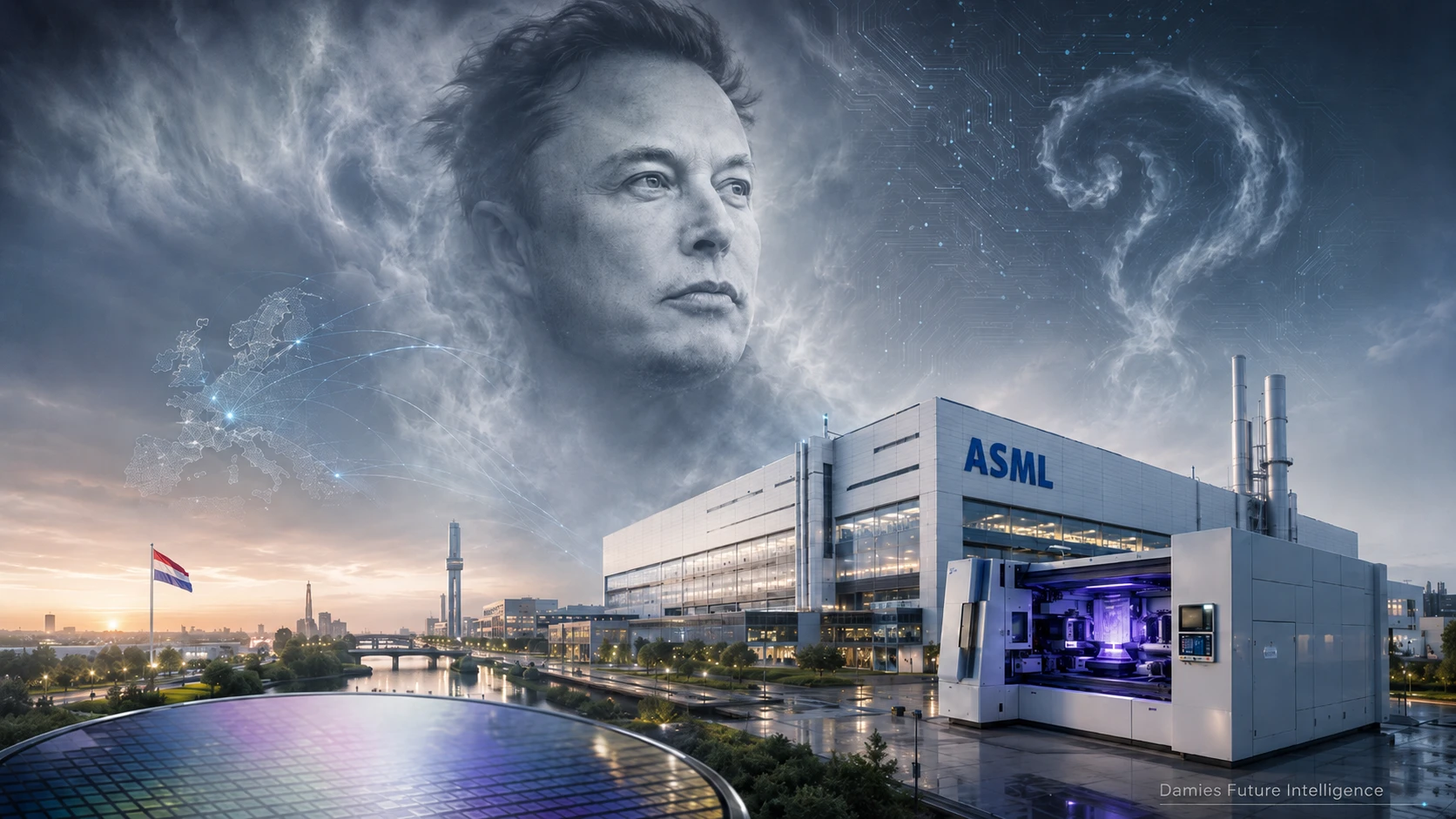
This essay builds on the earlier ManagementPro contribution, “From Lithography to Intelligence: Brainport’s Next Strategic Test. Why the ASML scenario has changed: AI-access sovereignty.”
That earlier argument was that ASML’s strategic position can no longer be understood through lithography alone. The centre of gravity is shifting from machines that make chips to the intelligence systems, AI models, access rules and geopolitical dependencies that increasingly determine who can design, produce and deploy advanced technology.
Terafab gives that argument a sharper edge.
Where the previous essay asked whether Brainport can move from lithography to intelligence, Musk’s Terafab raises the next question: what happens when one of the world’s most powerful private industrial actors tries to build his own vertically integrated AI-industrial stack, and needs ASML to do it?
In that sense, Terafab is not a separate story. It is the next chapter.
It shows that AI-access sovereignty is no longer only about access to frontier models. It is also about access to the physical chain underneath them: fabs, tools, suppliers, talent, energy, precision manufacturing and industrial execution.
The question therefore changes.
- Not: can Musk buy ASML?
- But: can Musk, through Terafab, bend part of the Brainport ecosystem towards his own AI sovereignty?
Musk at the Gate: Why Terafab Matters More Than a Takeover of ASML
When Elon Musk appears at the edge of Brainport, the instinctive question is almost cinematic: could the world’s richest entrepreneur buy ASML?
It is the wrong question.
The arithmetic is spectacular enough to attract attention. ASML’s market value is currently in the range of roughly three quarters of a trillion dollars. A serious takeover bid would normally require a significant premium, which means any credible offer would likely move towards one trillion dollars, possibly more. Since the SpaceX IPO has pushed Musk’s paper wealth beyond the trillion-dollar mark, the thought experiment becomes irresistible.
But paper wealth is not cash. A personal fortune built largely on equity in SpaceX, Tesla and related ventures is not a cheque sitting in a drawer. To buy ASML, Musk would need to liquidate, pledge or restructure enormous parts of his empire. That alone would create market risk, governance risk and political risk.
And even if the money could somehow be arranged, ASML is not an ordinary listed company waiting for the highest bidder. It is a strategic European technology node. Its machines sit at the narrowest point of the global semiconductor supply chain. Its role in extreme ultraviolet lithography makes it indispensable for the most advanced chips used in AI, high-performance computing, defence-related systems, robotics and next-generation industrial intelligence.
A hostile or politically sensitive acquisition would almost certainly face a Dutch and European wall of scrutiny. ASML also has a preference shares foundation designed to protect the company and its stakeholders against unwanted control. On top of that, Dutch investment screening rules around sensitive and highly sensitive technology make any significant influence over semiconductor capability a matter of national security.
So no: Musk buying ASML is not a realistic base scenario.
But that should not reassure us too quickly.
The more realistic scenario is subtler and potentially more important: Musk may not need to buy ASML in order to influence the strategic environment around it.
This is where Terafab enters the picture.
Terafab is not just another fab project. It is an attempt to build a private industrial nervous system for Musk’s empire: Tesla, SpaceX, xAI, Optimus robots, Starlink, autonomous systems and possibly space-based AI infrastructure. In other words, Terafab is not merely about producing chips. It is about controlling the physical foundation of an AI economy.
That changes the meaning of ASML’s role.
ASML would not simply be selling machines into another customer project. It would be enabling a vertically integrated AI-industrial stack in which chips, satellites, vehicles, robots, data centres, AI models and infrastructure converge. This is AI sovereignty in its most physical form.
Christophe Fouquet’s response is therefore strategically precise. New projects are an opportunity, but only if ASML is not supply limited.
That sentence deserves more attention than the headline about Musk.
Because the real scarce asset is not demand. There is plenty of demand. The scarce asset is capacity: machines, suppliers, engineers, cleanroom expertise, precision manufacturing, energy, logistics, maintenance capability and time. Terafab could become a gravity field inside that scarcity.
This is the real Musk effect on ASML and Brainport.
First, Terafab could reshape capacity allocation. If Musk becomes a massive, urgent and well-funded customer, he may not control ASML, but he can compete aggressively for future production slots, engineering attention and tool roadmaps. In a supply-limited industry, influence does not only come from ownership. It comes from being the customer around whom scarcity starts to bend.
Second, Terafab could put pressure on Brainport’s supplier ecosystem. ASML is not a standalone factory. It is the visible cathedral built on a hidden city of suppliers: optics, mechatronics, software, precision modules, materials, metrology, maintenance and systems integration. If Terafab adds another enormous wave of demand, the strain will not stop at ASML’s front gate. It will run through Veldhoven, Eindhoven and the wider Dutch and European high-tech chain.
Third, Musk can compete for talent. The greatest bottleneck in advanced technology is increasingly human. Engineers, system architects, AI specialists, lithography experts, supply-chain leaders and manufacturing talent are the real strategic inventory. Musk has a rare ability to turn industrial ambition into a recruitment myth. Brainport should not underestimate that pull.
Fourth, Terafab could influence the semiconductor roadmap. A customer of this scale does not merely place orders. It brings use cases, deadlines, technical demands and architectural preferences. If Terafab becomes a major project for AI chips, robotics and space infrastructure, it may help shape priorities around lithography, advanced packaging, tool productivity and future fab design.
Fifth, and most important, Terafab sharpens the sovereignty question.
In the recent ManagementPro entry on AI sovereignty, the central argument was that sovereignty is no longer only about who has access to AI models. It is also about who controls the stack underneath those models: chips, fabs, energy, data infrastructure, supply chains, tools, knowledge and industrial execution.
Terafab makes that argument tangible.
- The old semiconductor question was: who can buy the machines?
- The new AI-sovereignty question is: whose strategic system do those machines ultimately strengthen?
For the Netherlands and Europe, this is the moment to think beyond export revenue. ASML should of course do business. Brainport thrives because it is globally connected. But strategic openness is not the same as strategic naivety.
If Musk knocks on the Brainport gate, the question should not only be: how many machines does he want? The better question is: what does Brainport get back?
- Does Terafab strengthen the Dutch and European supplier base?
- Does it contribute to talent development in the region?
- Does it create reciprocal investment in European chip capacity?
- Does it protect critical knowledge?
- Does it support European AI-industrial autonomy, or mainly accelerate American private sovereignty?
- Does it make Brainport more resilient, or more dependent on the priorities of one external empire-builder?
This is not anti-Musk. It is pro-strategy.
Musk represents exactly the kind of actor that defines the new industrial age: capital-rich, vertically integrated, mission-driven, impatient and operating across sectors that used to be separate. Space, mobility, robotics, chips and AI are no longer separate industries. They are becoming one strategic system.
ASML and Brainport sit at a critical junction in that system.
That is why the takeover question is too narrow. Musk probably cannot buy ASML. But through Terafab he may still shape demand, capacity, talent flows and industrial priorities around ASML.
The real risk is not ownership, the real risk is becoming the machine room of someone else’s AI sovereignty.
And the real opportunity is equally clear: ASML and Brainport can use this moment to turn technological indispensability into strategic reciprocity: not just selling capacity but valuing position; not just serving global AI but shaping the terms on which global AI is built.
That is the next test for Brainport: not whether it remains essential, but whether it learns to convert being essential into lasting strategic autonomy.
Willem E.A.J. Scheepers, Strategist & AI Implementer
Deel uw ervaringen op ManagementSite
Wij zijn altijd op zoek naar ervaringen uit de praktijk, wat werkt wel, wat niet.
SCHRIJF MEE >>
Als u 3 of meer artikelen per jaar schrijft, ontvangt u een gratis pro-abonnement twv €200,--