
We tend to think of AI as a tool for efficiency. Something that helps us work faster, cheaper, and more productively. And at first glance, that’s exactly what it does. But that’s only the surface.
What AI is really doing is not just improving work. It is restructuring it. And in that restructuring, a clear pattern emerges. Not a gradual shift, but a split.
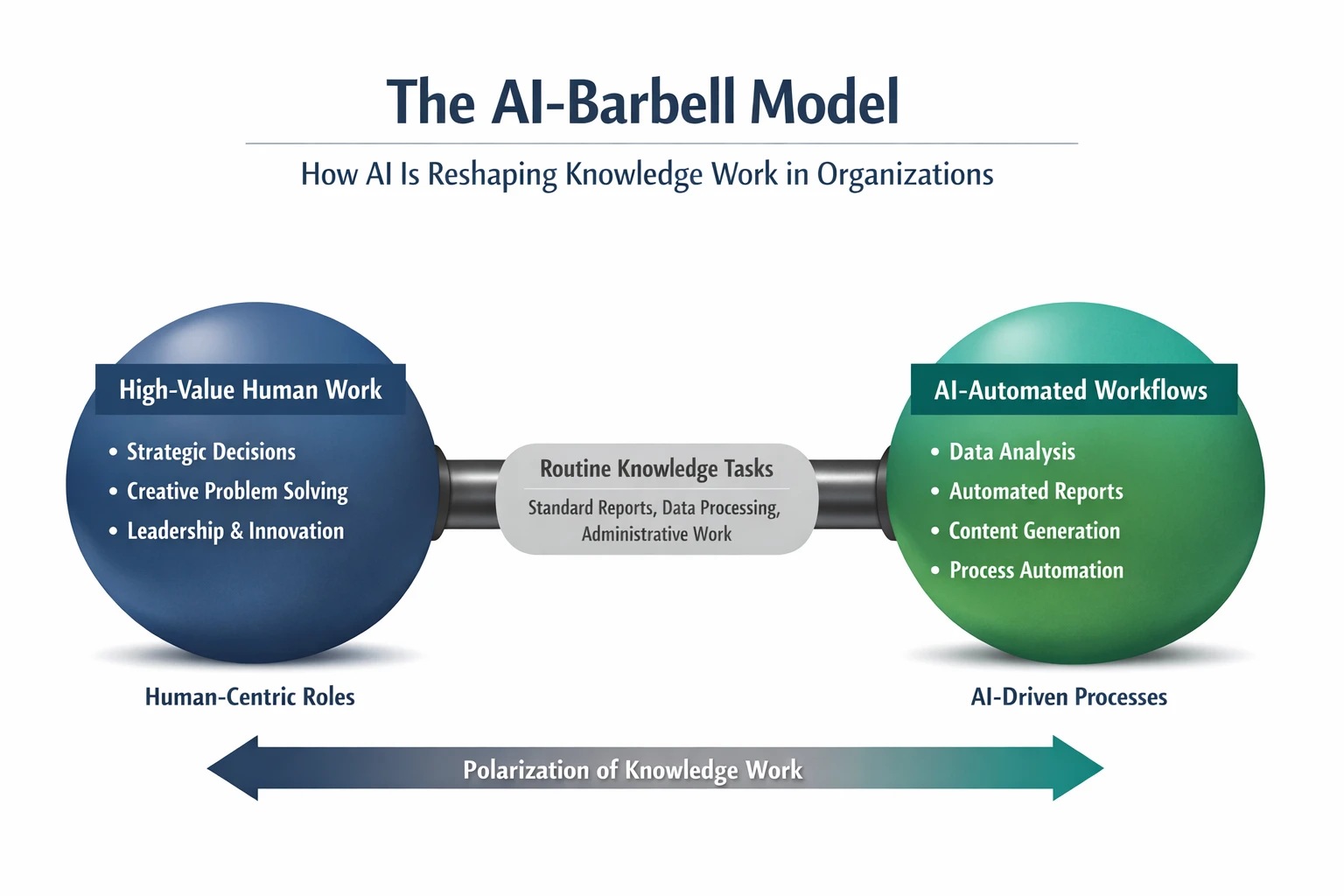
A Barbell.
On one side, work becomes highly standardized, predictable, and scalable. On the other, it becomes more complex, more interpretative, and more decisive. The middle — where much of today’s work still sits — starts to erode.
This is what I call the AI Barbell Model.
The Left Side: Efficiency at Scale
On the left side of the barbell, AI thrives.
These are tasks that are repetitive, rule-based, and predictable. Think of reporting, analysis, customer service interactions, administrative processes. AI systems handle these tasks faster, cheaper, and often more consistently than humans.
For organizations, this is where the immediate value lies. Costs decrease. Output increases. Processes accelerate.
But there is a trade-off.
As work becomes more standardized, it also becomes more interchangeable. Competitive advantage shifts away from execution and toward cost efficiency and scale. Margins come under pressure. Differentiation becomes harder.
In other words: the left side optimizes performance, but commoditizes it at the same time.
The Right Side: Judgment and Direction
On the right side of the barbell, something very different happens.
Here, work is not about execution, but about interpretation. It involves making decisions in uncertain contexts, setting direction, weighing trade-offs, and taking responsibility.
These are tasks AI cannot easily replicate, not because of technical limitations alone, but because they require context, accountability, and human judgment.
As AI takes over more of the execution, these roles do not disappear. They become heavier.
Fewer people are needed, but their impact increases. Decisions carry more weight. The consequences of getting it wrong are higher.
This is where value concentrates.
The Disappearing Middle
The real tension lies in the middle.
For decades, organizations have been built around roles that coordinate, translate, and control. Middle management layers, specialist roles, and process-driven functions.
This middle layer has always been essential. It connects strategy to execution. It ensures alignment. It manages complexity.
But AI is now taking over many of these coordinating functions.
What used to require layers of management can increasingly be handled through direct interaction between humans and systems. Information flows faster. Decisions can be made closer to the source.
The result is not a gradual reduction, but a structural shift.
The middle starts to disappear.
Not an Efficiency Problem, but a Design Problem
Many organizations still approach AI as an efficiency challenge. How can we reduce costs? How can we automate more?
But that perspective misses the bigger picture. This is not just about doing the same work faster. It is about redefining where value is created.
The AI Barbell Model shows that work is not evenly redistributed. It is polarized.
-
On one side: extreme efficiency
-
On the other: concentrated responsibility
-
In between: declining relevance
This has profound implications for how organizations are designed.
Implications for Organizations
If the middle is shrinking, the traditional pyramid structure becomes less effective.
Organizations are no longer shaped as stable hierarchies. Instead, they become more polarized systems:
-
A highly automated operational core
-
A smaller, more influential layer of decision-makers
The challenge is not to flatten the organization, but to reconnect these two extremes.
Because without that connection, two risks emerge:
-
The left side becomes efficient but directionless
-
The right side becomes decisive but disconnected from execution
Implications for Professionals
For individuals, the consequences are just as significant.
The key dividing line is no longer job title or contract type, but adaptability.
-
Can you work with AI, or are you replaced by it?
-
Do you add judgment, or execute tasks?
-
Do you shape outcomes, or follow processes?
The safest position is no longer in the middle.
It is at the edges.
The Strategic Question
The AI Barbell Model leads to a fundamental question for every organization and professional:
Where are you positioned? Not in terms of hierarchy, but in terms of value creation.
Because in a world shaped by AI, survival is not about being the strongest or the most efficient.
It is about being positioned on the side where value still accumulates.
What shape will our organization take when AI becomes part of the work?
Part of the AI Barbell research by Willem Scheepers:
'The AI-Barbell Model: Measuring the Polarization of Knowledge Work in the Age of Artificial Intelligence. A task-based research framework and measurement model for understanding how AI transforms organizational structures and the division of work' (2026)
“For those interested, the SSRN paper is available via this link.
Deel uw ervaringen op ManagementSite
Wij zijn altijd op zoek naar ervaringen uit de praktijk, wat werkt wel, wat niet.
SCHRIJF MEE >>
Als u 3 of meer artikelen per jaar schrijft, ontvangt u een gratis pro-abonnement twv €200,--