
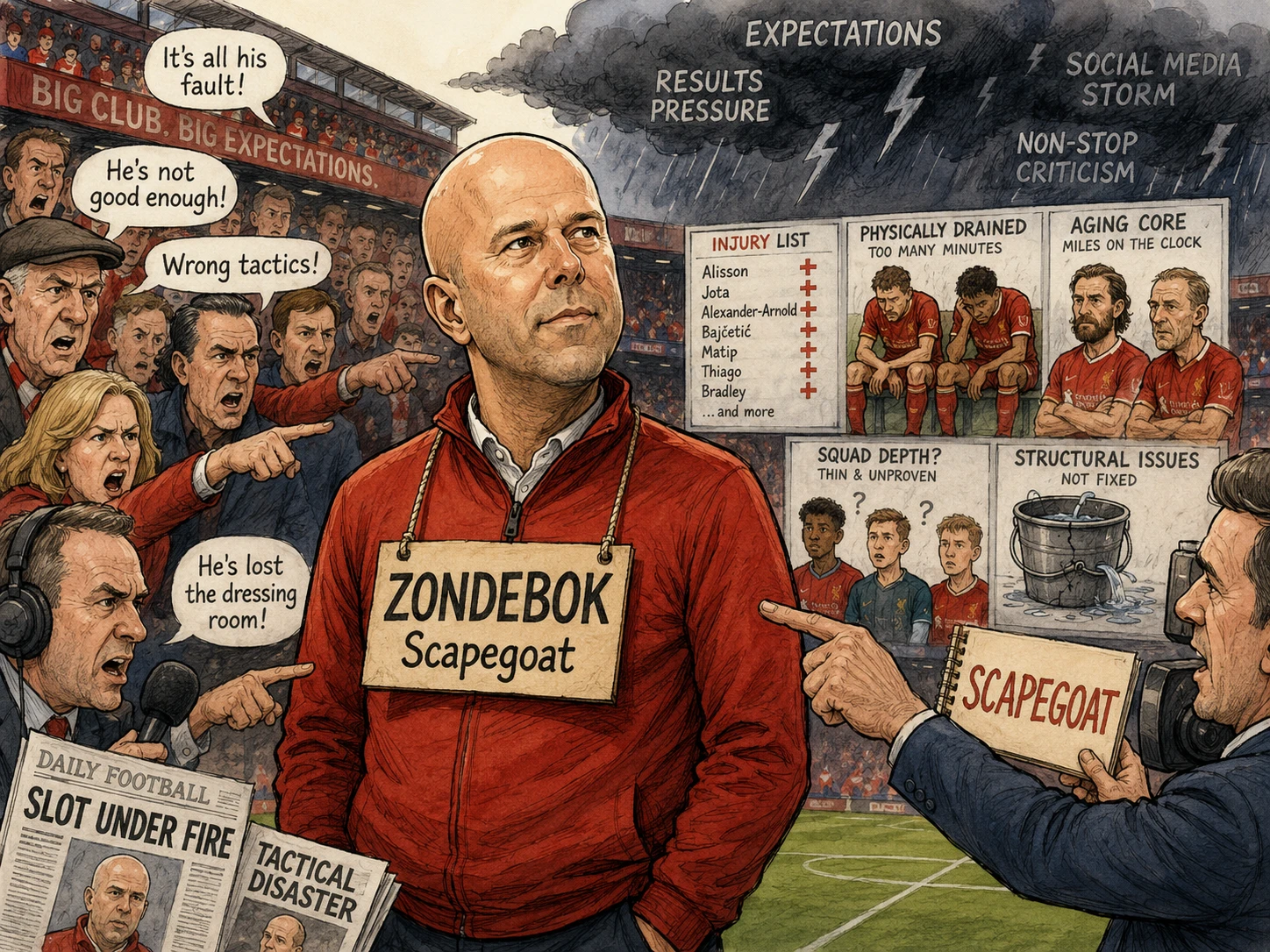
Arne Slot’s dismissal at Liverpool feels like a classic scapegoating operation. A difficult season, a declining team, injuries, grief, departing players, poor form and an increasingly vocal group of supporters were ultimately compressed into one simple conclusion: Slot had to go. But it was not that simple. In fact, football rarely is.
Arne Slot arrived at a club that had just said goodbye to Jürgen Klopp. That alone is an almost impossible inheritance. Klopp was not just any manager. For years, he was the face, the energy and the emotional engine of Liverpool. When someone like that leaves, more disappears than a tactical plan. An era disappears.
On top of that, many of the players from the great Klopp years had grown older. Liverpool won the Champions League under Klopp and later the Premier League as well. Those were magnificent years, but teams like that do not remain at their peak forever. Players who were once fresh, hungry and explosive get older. Their legs become heavier. Their sharpness fades. Their sense of inevitability disappears. You cannot simply blame the new manager for that.
Virgil van Dijk held up reasonably well. But other players no longer reached the level they had reached before. Mohamed Salah, for years an absolute certainty, fell far below his previous standards this season. And it was precisely Slot who was then given the thankless task of making difficult decisions around such a star player. In the media and among supporters, (halfway the season) the calls grew louder that Salah had to be dropped. When Slot did this, he once again took the full force of the criticism, especially from Salah himself. That is the paradox of elite football: if you do nothing, you are weak; if you intervene, you are accused of touching the hero status of an icon.
Then there was the tragic death of Diogo Jota. Anyone who thinks something like that does not affect a group of players understands very little about human beings. A football team is not a machine. It is a group of young men, coaches and staff members who live and work with one another day after day. Grief, shock and disruption do not disappear simply because another match has to be played on Saturday. Something like that runs through a dressing room, through a club, through an entire season.
Sportingly, too, a great deal went against Liverpool. There were injuries. New players had to adapt to the relentless rhythm of the Premier League. Some were not fit; others did not immediately reach the level Liverpool demands. Important players left. Luis Díaz and Darwin Núñez were names who brought energy, threat and depth to the team. When players like that disappear and their replacements are not immediately available or fully integrated, the entire attacking game changes.
A manager can be excellent, but football is ultimately decided on the pitch. Chances have to be finished. Defenders have to stay alert in the final minutes. Midfielders have to win their duels. Players have to be fit, sharp and mentally free. A manager can create the conditions, but he cannot put the ball into the net himself. Of course he can make tactical mistakes, everybody does, but Slot is the first to admit that he is not perfect. Who is?
Yet over the course of the season, an atmosphere developed in which everything was attributed to Slot. Injuries? Slot. Loss of form? Slot. Bad luck in the closing stages? Slot. A team in decline? Slot. Klopp’s departure? Slot. The emotional damage after Jota? Slot. Missed chances? Slot.
That is exactly how the scapegoat mechanism works. A complex problem is reduced to one person. The group no longer has to look at the complexity. The club no longer has to acknowledge that a year of transition can be painful. Supporters no longer have to endure the fact that their team is no longer what it once was. There is one face onto which everything can be projected. And that face became Arne Slot.
What makes this particularly irritating is that Slot had, in a very short time, already proved that he could handle this level. In the Netherlands, he had already shown himself to be an excellent manager: tactically strong, calm, clear and modern. In his first season at Liverpool, he won the Premier League. That is not a fluke. That is not a trophy you win simply because you happen to be standing on the touchline. A manager who wins the league in his first year after Klopp deserves credit. Again: the players first, but the manager as well.
But when things went badly afterwards, a group of fans began a strange reinterpretation. The title was supposedly still Klopp’s. Slot had merely harvested what Klopp had sown. But that is a weak argument. If that same team did not win Klopp’s final title under Klopp, why should Slot’s title suddenly not belong to Slot? Of course, he built on a foundation. Every manager does. But he still had to do it. He still had to get the group behind him. He still had to win the matches. He still had to carry the pressure of succeeding Klopp.
And he did.
That is precisely why his dismissal is so bitter. Liverpool did not simply sack a failing manager. Liverpool sent away a manager who had a difficult second year in a context in which almost everything went against him. That is something different. It is the difference between incompetence and adversity. Between failure and being caught in a storm.
There was a group of fans who shouted 'Slot out' louder and louder. Sentimental fans that could not say goodbye to the Klopp-era and could not accept that transition takes time. In modern football, such voices can quickly create their own reality. Social media amplifies the effect. Discontent looks for a name, a face, a target. And once that process begins, every incident becomes evidence. Every substitution is wrong. Every injury is poor management. Every defeat confirms the verdict that was already waiting.
Yet there were also enough experts who understood that Slot deserved credit. They saw that the season was much more than a managerial problem. They saw a club in transition, a changing squad, an attack that had lost power, a grieving process, an injury crisis and a group of players who no longer automatically possessed the same energy as they had in the glory years.
Slot is not a colourless, conservative manager who cannot get a team moving. That image is far too easy and not right, as he proved in the years before last season. He is a top manager. He has vision, he has calmness, a decent guy to the press and fans, he has tactical intelligence and he has proved that he can make players better. That does not disappear because one season, under extreme circumstances, goes wrong.
Of course football is harsh. Of course managers are judged by results. Of course a club’s leadership can decide that a different course is needed. But that does not make the judgment right. Sometimes a dismissal may be understandable from a managerial point of view and still be unjust from a footballing one. That appears to be the case with Arne Slot.
Liverpool should have given him another year. A year to truly process the grief, the injuries, the transfers and the aftermath of Klopp. A year to integrate new players. A year to show whether, after the storm, he could build again. He will not get that year.
My conviction is that Liverpool will come to regret this. Arne Slot will show again in the coming years that he is a top manager. And perhaps there will come a moment when people at Liverpool look back and realise that his dismissal was not an act of clear leadership, but a surrender to the pressure of a mood. A club in confusion was looking for someone to blame. And it found Arne Slot.
The new trainer of Liverpool will have an easier inheritance. It is the inheritance of a scapegoat who left behind wonderful players. In the last season many of them were injured, but that will be better in the forthcoming season. Also the departure of Salah is good for a new fresh season. The team needs new stars and another era. With a combination of control and excitement. Let's say a combination of the strategies of Klopp and...Arne Slot.
Deel uw ervaringen op ManagementSite
Wij zijn altijd op zoek naar ervaringen uit de praktijk, wat werkt wel, wat niet.
SCHRIJF MEE >>
Als u 3 of meer artikelen per jaar schrijft, ontvangt u een gratis pro-abonnement twv €200,--